
Why Indoor Air Quality Matters in Healthcare Facilities

Healthcare facilities depend on more than skilled medical professionals and advanced equipment to deliver quality care. The air inside the building plays a direct role in patient recovery, infection prevention, staff wellbeing, and regulatory compliance.
From hospitals and outpatient clinics to surgical centers, rehabilitation facilities, and senior living communities, maintaining indoor air quality (IAQ) is a critical responsibility. Every day, healthcare facilities welcome patients with weakened immune systems, healthcare workers moving between departments, and visitors from outside environments. Without properly designed and maintained HVAC systems, airborne contaminants can spread quickly throughout the building.
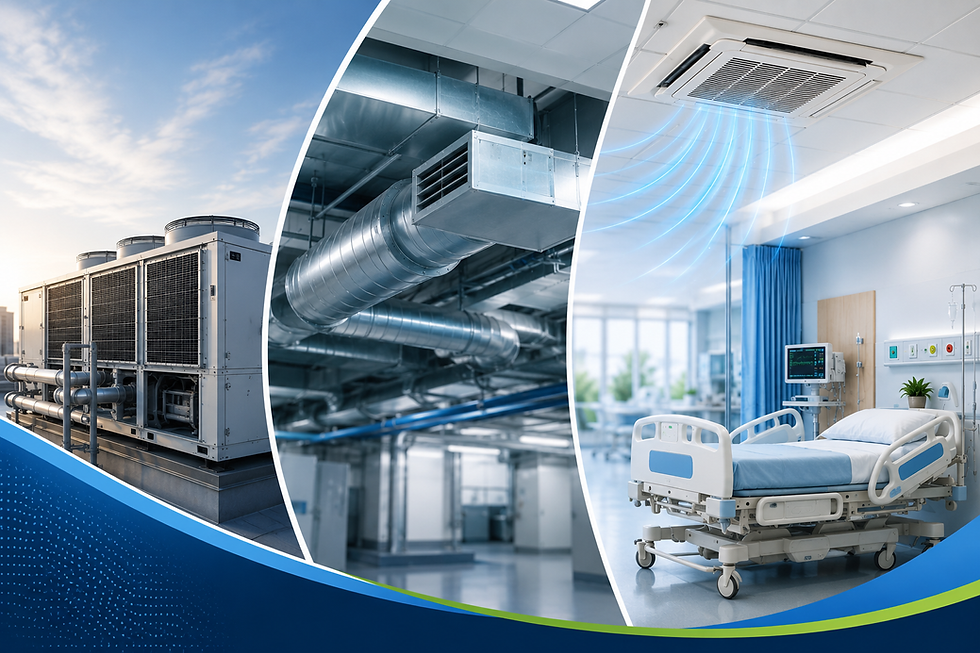
Proper commercial HVAC for healthcare facilities plays a critical role in maintaining safe, comfortable, and healthy indoor environments while supporting the daily operations of medical buildings.
For healthcare facility managers, building owners, and contractors, indoor air quality is not simply a comfort issue. It is an essential part of facility operations.
What Is Indoor Air Quality in Healthcare Facilities?
Indoor air quality refers to the condition of the air inside a building and how it affects the health, comfort, and safety of occupants. In healthcare environments, IAQ involves controlling airborne particles, temperature, humidity, ventilation rates, and air pressure relationships between spaces.
Healthcare facilities face unique challenges because different areas require different environmental conditions. An operating room has significantly different ventilation requirements than a waiting room, patient room, imaging center, or administrative office.
Commercial HVAC systems must continuously manage these environments while operating around the clock.
Why Healthcare Facilities Have Higher IAQ Requirements
Unlike many commercial buildings, healthcare facilities operate 24 hours a day and serve populations that are more vulnerable to airborne contaminants.
Poor indoor air quality can contribute to:
· Increased risk of airborne infection transmission
· Patient discomfort and slower recovery
· Employee fatigue and respiratory irritation
· Odors and chemical exposure
· Mold growth caused by improper humidity control
· Regulatory compliance concerns
· Increased operational costs due to inefficient HVAC performance
In healthcare environments, HVAC performance directly impacts both patient outcomes and business operations.
Common Air Quality Challenges in Healthcare Buildings
Healthcare facilities encounter a wide range of airborne contaminants and environmental concerns.
Airborne Particulates
Dust, skin cells, fibers, pollen, and microscopic particles can circulate through occupied spaces if filtration systems are not properly maintained.
Biological Contaminants
Bacteria, viruses, fungal spores, and other microorganisms present a constant challenge in healthcare settings, particularly in high-traffic or high-risk areas.
Volatile Organic Compounds (VOCs)
Cleaning chemicals, disinfectants, sterilization products, paints, adhesives, and building materials can release VOCs into the indoor environment.
Improper Humidity Levels
Low humidity can increase the survival rate of certain airborne pathogens, while excessive humidity creates favorable conditions for mold growth and microbial activity.
Inadequate Ventilation
Insufficient outdoor air exchange can allow contaminants and carbon dioxide levels to build up inside occupied spaces.
Areas That Require Specialized HVAC Attention
Healthcare facilities are not designed with a one-size-fits-all ventilation strategy. Different areas have different airflow and pressure requirements.
Operating Rooms
Operating rooms require tightly controlled temperature, humidity, filtration, and air exchange rates to minimize contamination risks during procedures.
Isolation Rooms
Negative pressure rooms help prevent airborne contaminants from spreading to surrounding areas.
Intensive Care Units
ICUs house highly vulnerable patients who require stable environmental conditions and enhanced air filtration.
Emergency Departments
Emergency departments experience heavy traffic and unpredictable patient volumes, making ventilation performance especially important.
Waiting Areas
Waiting rooms bring together patients, visitors, and staff from multiple environments, increasing exposure risks if ventilation is inadequate.
Laboratories
Healthcare laboratories may contain chemicals, biological materials, and equipment that require dedicated exhaust and ventilation systems.
How Commercial HVAC for Healthcare Facilities Supports Better Indoor Air Quality
An effective commercial HVAC system performs several critical functions simultaneously:
· Filtration of airborne particles
· Ventilation using outdoor air
· Temperature control
· Humidity management
· Air pressure balancing
· Air distribution throughout occupied spaces
If one of these components fails, indoor air quality can deteriorate quickly.
Healthcare facilities cannot afford unexpected HVAC downtime or inconsistent system performance. This is why investing in reliable commercial HVAC for healthcare facilities is essential for protecting patients, supporting staff productivity, and maintaining compliance requirements.
Why Preventive Maintenance Is Essential
Many indoor air quality problems begin with deferred maintenance.
Dirty filters, clogged coils, malfunctioning dampers, failing sensors, and poorly calibrated controls can all reduce HVAC effectiveness and compromise building performance.
Preventive maintenance helps healthcare facilities:
· Improve filtration performance
· Maintain proper airflow rates
· Extend equipment life
· Reduce emergency repair costs
· Improve energy efficiency
· Support regulatory compliance
· Identify problems before they impact occupants
For facilities operating continuously, proactive maintenance is often significantly less expensive than emergency repairs or operational disruptions.
Humidity Control Is More Important Than Many Facilities Realize
Humidity control is one of the most overlooked aspects of healthcare HVAC management.
Excess humidity can contribute to:
· Mold growth
· Condensation issues
· Equipment damage
· Indoor air quality complaints
Low humidity can contribute to:
· Dry respiratory passages
· Increased airborne particle movement
· Occupant discomfort
Maintaining stable humidity levels helps support both patient comfort and building performance.
Energy Efficiency and Indoor Air Quality Can Work Together
Healthcare facilities often assume that improving indoor air quality automatically increases operating costs.
Modern HVAC technologies allow facilities to improve IAQ while managing energy consumption through:
· Building automation systems
· Variable air volume controls
· Demand-controlled ventilation
· Energy recovery systems
· High-efficiency filtration solutions
· Continuous system monitoring
When HVAC systems are properly designed and maintained, facilities can improve occupant safety while controlling operating expenses.
Signs Your Healthcare Facility May Have IAQ Problems
Facility managers should pay attention to warning signs that may indicate indoor air quality issues.
Common indicators include:
· Frequent occupant complaints
· Hot or cold spots throughout the building
· Persistent odors
· Excess humidity or condensation
· Visible mold growth
· Increased employee illness or absenteeism
· Rising energy costs
· Inconsistent air pressure between rooms
Early intervention can prevent small issues from becoming major operational challenges.
Why HVAC Expertise Matters in Healthcare Environments
Healthcare facilities are among the most demanding commercial environments for HVAC systems.
Maintaining proper indoor air quality requires more than replacing filters or responding to breakdowns. It requires a long-term strategy that combines system design, preventive maintenance, performance monitoring, and operational expertise.
Working with an experienced commercial HVAC contractor helps healthcare organizations maintain reliable building performance while protecting patients, staff, and visitors.
Supporting Healthcare Facilities Across the Southeast
Healthcare organizations need HVAC partners who understand the complexity of mission-critical environments.
With decades of commercial HVAC experience serving businesses throughout the Southeast, JR Hobbs delivers installation, maintenance, repair, and emergency services designed to support reliable building performance and long-term operational efficiency.
Partnering with an experienced provider of commercial HVAC for healthcare facilities helps healthcare organizations maintain indoor air quality, improve operational reliability, and create safer environments for patients and staff.
For healthcare facilities, indoor air quality is more than a regulatory requirement. It is a critical component of patient care, staff safety, and facility resilience.
Frequently Asked Questions
Why is indoor air quality important in healthcare facilities?
Indoor air quality is critical in healthcare facilities because patients, staff, and visitors spend long periods inside the building. Proper ventilation, filtration, and humidity control help reduce airborne contaminants and support healthier indoor environments.
How do HVAC systems improve indoor air quality in hospitals and medical facilities?
Commercial HVAC systems improve indoor air quality by filtering airborne particles, controlling humidity levels, supplying fresh outdoor air, and maintaining proper airflow throughout the facility.
What are the most common indoor air quality problems in healthcare facilities?
Common issues include poor ventilation, excess humidity, airborne particles, odors, mold growth, and inadequate filtration.
Which areas of a healthcare facility require the most HVAC attention?
Operating rooms, intensive care units, isolation rooms, laboratories, emergency departments, and waiting areas typically require stricter environmental controls.
How often should healthcare HVAC systems be maintained?
Healthcare HVAC systems should be inspected and maintained regularly as part of a preventive maintenance program to ensure reliable operation and consistent indoor air quality.
Can improving indoor air quality reduce operating costs?
Yes. Efficient HVAC systems can reduce energy consumption, lower emergency repair costs, and improve overall building performance.
What are signs of poor indoor air quality in a healthcare building?
Common signs include inconsistent temperatures, persistent odors, excess humidity, mold growth, occupant complaints, and increasing energy costs.
Why is preventive HVAC maintenance important for healthcare facilities?
Preventive maintenance helps identify problems early, improves system reliability, extends equipment life, and supports healthy indoor environments.


.png)
Comments